SEO vs Google Ads: Which Should a Small Business Start With?
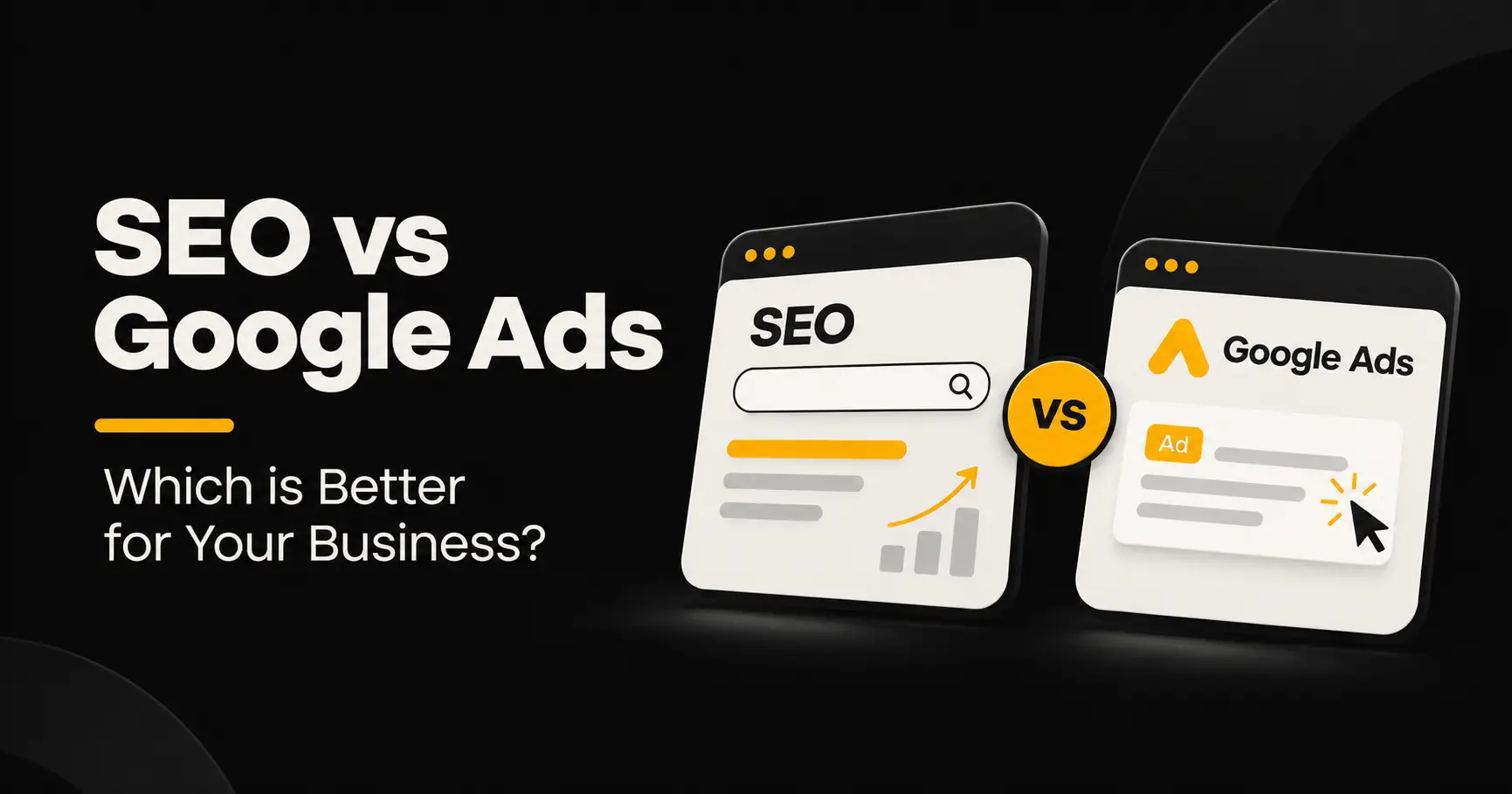
If you run a small business, you will hear two pieces of advice: invest in SEO, or run Google Ads. Both can bring enquiries, but they work very differently, and starting with the wrong one can waste months or a lot of money.
The short answer: Start with Google Ads if you need enquiries within weeks and can fund a small test. Start with SEO if you can wait months for lasting visibility. Many businesses use both over time, and either way your website must be ready first. The right order depends on urgency, budget, competition and what a customer is worth to you.
This guide compares the two side by side, explains how each one works and what you pay, helps you decide with five questions and a simple break-even calculation, and ends with a 90-day plan for running both on a small budget.
SEO vs Google Ads at a glance
| SEO | Google Ads | |
|---|---|---|
| Speed to first results | Weeks to months. Early signs often come in the first 4 to 8 weeks. | Days, once your campaign is approved and running |
| How you pay | Your time, content and tools. No charge per click. | A charge each time someone clicks your ad |
| Control | Indirect. You improve your site, Google decides the results. | High. You choose searches, ad text, page, budget cap and schedule. |
| How long results last | Builds over time and keeps working, but needs upkeep | Stops when you stop paying |
| Main risk | Slow start and no guaranteed date | Paying for clicks that never become enquiries |
| Best when | You can wait and want lasting visibility | You need enquiries soon and have a clear offer and a test budget |
The verdict: Neither is better in general. Ads buy speed and control. SEO builds visibility that keeps working. Which comes first depends on your situation, and the rest of this guide helps you work that out.
What is SEO, and how does it pay off?
SEO (search engine optimization) is the work of making your website easier for search engines to find and understand, and more useful to the people searching, so your pages appear in the unpaid results.
The main appeal is that you do not pay for each click. A page that ranks keeps bringing visitors without a bill for every visit, and the work builds on itself as you add more useful pages. The trade-off is time. SEO has no fixed timeline and nobody can guarantee a ranking date. For what to expect, read how long SEO takes.
If you want help with this side, see my SEO services.
What is Google Ads, and how do you pay?
Google Ads is Google's pay-per-click advertising platform. You choose the searches you want to appear for, write an ad, set a budget, and pay when someone clicks.
Here is how it works, based on Google's own explanation of the ad auction:
- Every search triggers an auction. It runs each time someone searches on Google or visits a site that shows ads.
- Your bid is only one factor. Where your ad appears depends on your bid, the quality of your ad and landing page, the expected effect of extras such as added links, minimum quality thresholds, the context of the search (words, device, time and more), and how strong the competition is.
- The highest bid does not always win. A more relevant ad and a better page can win a higher position than a competitor who bids more.
- You often pay less than your maximum bid. Google describes actual cost-per-click as the final amount you are charged for a click, and says it is often less, sometimes much less, than your maximum. With standard bidding you are never charged more than that maximum.
In practice, this means a clear, relevant page and a well-matched ad can lower what you pay, while sending clicks to a weak page makes every click cost more than it should. If you want this side set up and managed, see my Google Ads management service.
Myth: running ads will help my rankings
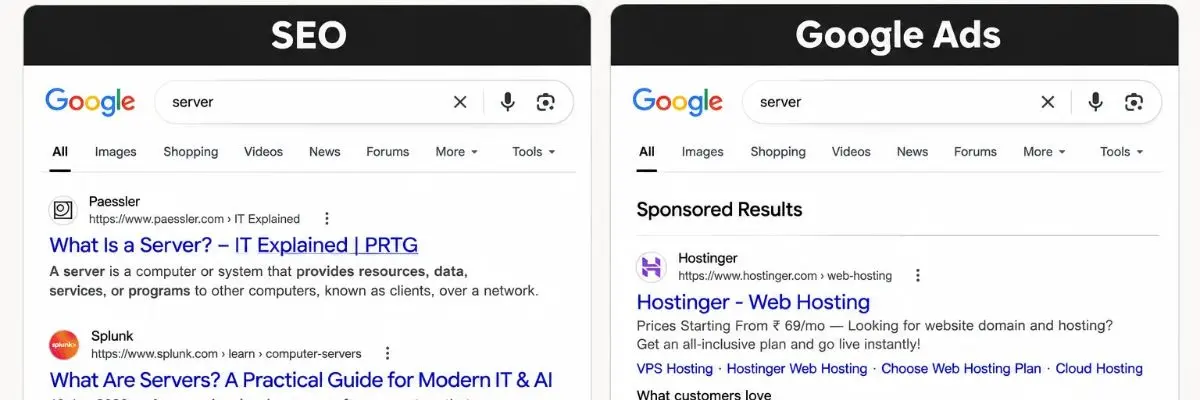
It will not, according to Google. Ads appear under an "Ads" label and are ordered by a mix of bid and relevance. Organic results are ordered by things like relevance and popularity. Google's help page on how search results differ from ads says its search results are independent of its advertising programs.
Google's John Mueller put it more directly in a 2021 video, reported by Search Engine Roundtable: running or removing Google Ads does not affect organic rankings, because the systems are separate. That statement is from 2021, so treat it as a clear past statement, not a new announcement.
So do not run ads in the hope of ranking higher. The two channels do help each other in a practical way, though. The search terms report in Google Ads shows the exact words people typed before clicking, which gives you ideas for pages and posts. And your organic data shows which pages already bring visitors, which helps you choose where to send ad clicks.
How to decide: five questions
Answer these honestly, then use the table below.
- How soon do you need enquiries? If it is within weeks, Google Ads fits better. If you can wait three to six months or more, SEO is a good first investment.
- What can you spend to test? Ads need a budget you can afford to learn with. SEO needs mostly time, so if cash is tight but you can publish and improve pages regularly, SEO is realistic.
- Do people already search for what you sell? Check the Google Keyword Planner, Google's autocomplete suggestions and, if you have data, Search Console. Many specific searches mean both channels have something to work with. Very few searches mean neither can create demand that is not there.
- Is your website ready? It should load quickly on a phone, make your offer clear, give one obvious next step, and track enquiries. If not, fix that first, because your website is the foundation of every channel. My SEO audit checklist shows how.
- What is a customer worth to you? The higher your profit per customer, the easier it is to justify paying for clicks. The next section shows how to check.
| Your situation | Start with | Add next |
|---|---|---|
| You need enquiries soon, have a clear offer and a test budget | A small, tightly controlled Google Ads campaign | SEO basics in parallel |
| You can wait, have little cash and can publish regularly | SEO | Ads later, on your best-converting searches |
| Each customer is worth a lot and many people search for your service | Both, with small budgets | Move effort to whichever brings better leads |
| Few people search for what you sell yet | Build awareness first through content, social media and referrals | SEO and ads once searches appear |
| Your website is slow, unclear or has no tracking | Fix the website | Then follow the row that fits you |
Do the maths before you spend
Before you pay for a single click, work out the most you can afford to pay for a lead. Use profit, not sales, because sales do not include what it costs you to serve the customer.
Maximum cost per lead = average profit per customer x share of leads that become customers
An example, with made-up numbers (use your own, in your own currency):
- Average profit per customer: 10,000
- 1 in 5 leads becomes a customer, which is 20%
- Maximum cost per lead: 10,000 x 0.20 = 2,000
If only 1 in 10 leads became a customer (10%), the maximum falls to 10,000 x 0.10 = 1,000.
Your actual cost per lead is the money you spend on ads divided by the number of leads you get. Run a small test, then compare the two numbers. If your real cost per lead is well above your maximum, improve the page and the offer, narrow the searches you target, or lean on SEO instead. If it is comfortably below, you have room to grow the budget.
Four common situations
1. "I need enquiries this month." Start with a small Google Ads campaign aimed at searches that show clear intent to buy or hire. Set a daily cap, add negative keywords, and send people to one focused page. Start SEO basics at the same time, so you are not paying for every visit forever.
2. "I have very little money, but I have time." Start with SEO. Fix the site, build useful pages for the questions your customers ask, and publish regularly. Expect to wait. Keep your Google Business Profile and local listings accurate in the meantime, and use referrals to bring in early work.
3. "Lots of people already search for my service." This is where both channels pay off. Use ads to win enquiries now and to learn which searches turn into customers. Then put your SEO effort into those same topics.
4. "Hardly anyone searches for what I sell." Neither channel can create demand that is not there. Build awareness first through content, social media, partnerships and word of mouth, and return to search once people begin to look for you.
A simple 90-day plan for a small budget
This plan suits most small businesses that want to test both channels without overspending. Adjust the details to your business.
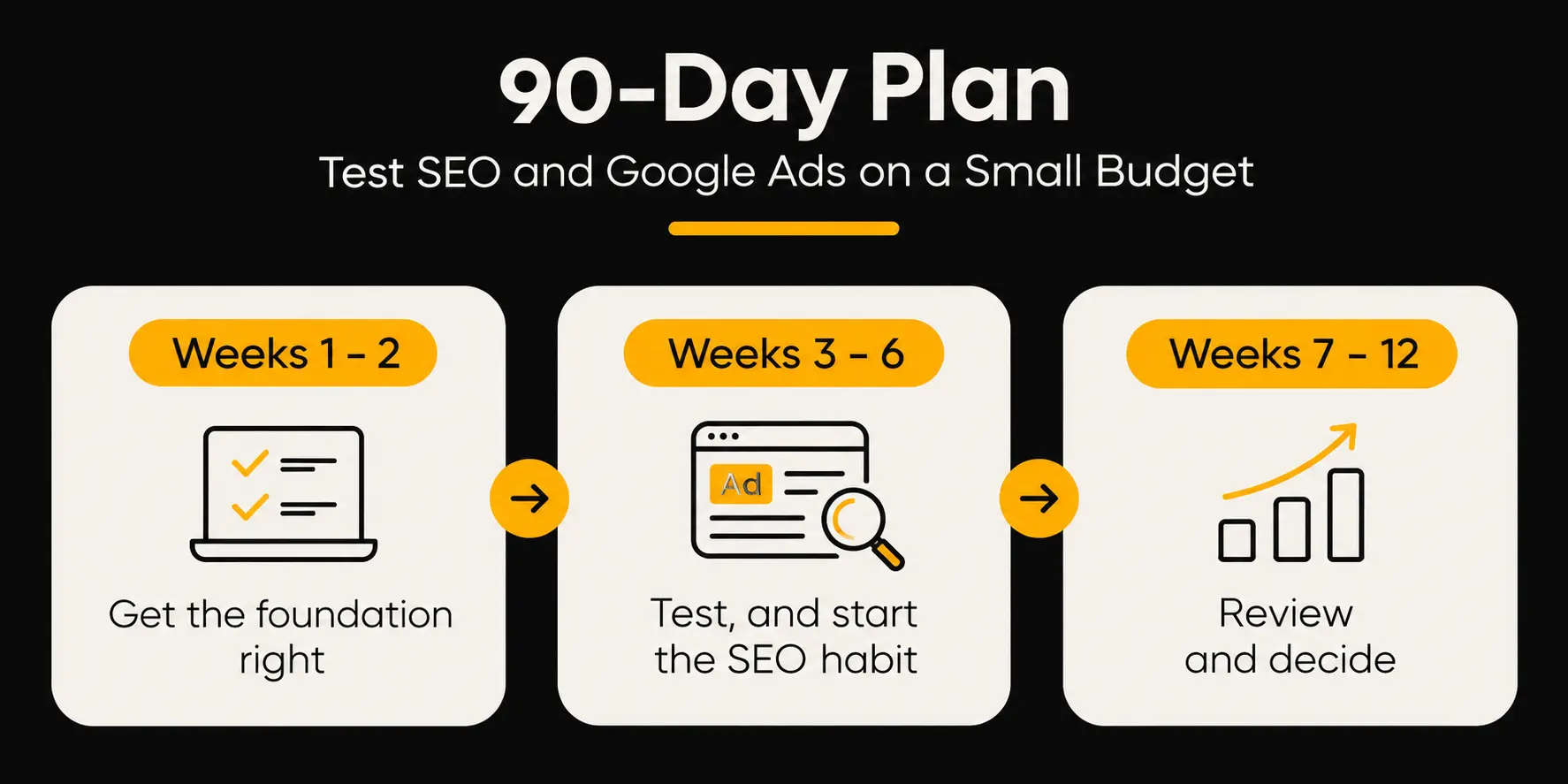
Weeks 1 to 2: get the foundation right
- Run through my SEO audit checklist and fix the high-impact, low-effort items first.
- Make sure one page clearly explains your offer and gives one obvious next step, such as a call, form or WhatsApp message.
- Set up conversion tracking so you can count calls, form submissions and messages. Without it you cannot judge either channel.
- Work out your maximum cost per lead using the maths above.
Weeks 3 to 6: test, and start the SEO habit
- Launch a small Google Ads campaign on 5 to 10 high-intent searches, with a daily cap you can afford.
- Add negative keywords from the first week, and review the search terms report regularly.
- Publish one useful page or post a week that answers a real customer question.
Weeks 7 to 12: review and decide
- Compare your actual cost per lead with your maximum. Check lead quality too, not only the number of leads.
- Pause searches that spend money without bringing enquiries, and put more behind the ones that work.
- In Search Console, look at which pages are starting to get impressions and clicks, and improve those first.
- Decide where the next month of effort and budget goes.
Mistakes to avoid
- Sending ad traffic to a weak page. A slow, unclear page wastes every click you pay for.
- Running ads without conversion tracking. You will not know which searches bring enquiries and which only bring clicks.
- Targeting broad keywords. Searches that are too general bring visitors who are not ready to buy. Start with specific, high-intent phrases.
- Skipping negative keywords. Irrelevant searches can use up a small budget quickly.
- Judging SEO after a few weeks. It takes time, and the SEO timeline post explains what to expect and which early signs to watch.
- Stopping ads the moment the budget feels tight, without checking cost per lead. Compare it with your maximum first. Cutting a profitable campaign is as costly as keeping a losing one.
- Treating the two as rivals. They work best as one plan, as I explain in digital marketing is strategy, not a collection of channels.
Frequently asked questions
Is SEO better than Google Ads?
Neither is better for every business. SEO builds lasting visibility but takes months. Google Ads can bring enquiries within weeks but stops when you stop paying. The better choice depends on how soon you need leads, your budget, how much competition you face, and what a customer is worth to you.
Can I do both SEO and Google Ads on a small budget?
Yes. Put a small, capped amount into ads on a handful of high-intent searches, and spend your time on SEO basics and one useful page a week. Review the results after 90 days and move effort towards whichever brings better leads.
Does Google Ads help SEO?
No. Google states that its search results are independent of its advertising programs, and paying for ads does not improve your organic rankings. Ads can still help indirectly, because the search data shows which keywords turn into enquiries.
Which is better for a new website?
A new website has little authority, so SEO results usually take longer. If you need enquiries soon and the site is ready, a small Google Ads test can bring them sooner. If the site is not ready, fix it first, since weak pages waste both ad spend and search visibility.
How quickly does Google Ads give results?
Ads can start showing as soon as your campaign is approved, so clicks and enquiries can begin within days. Results vary by competition, budget, ad quality and how well your page matches the search. It usually takes a few weeks of adjusting to find what works.
Not sure which to start with?
If you would like a second opinion on your own situation, I can help you plan the first 90 days. Take a look at my performance marketing services for Google Ads, or my SEO services for organic growth.