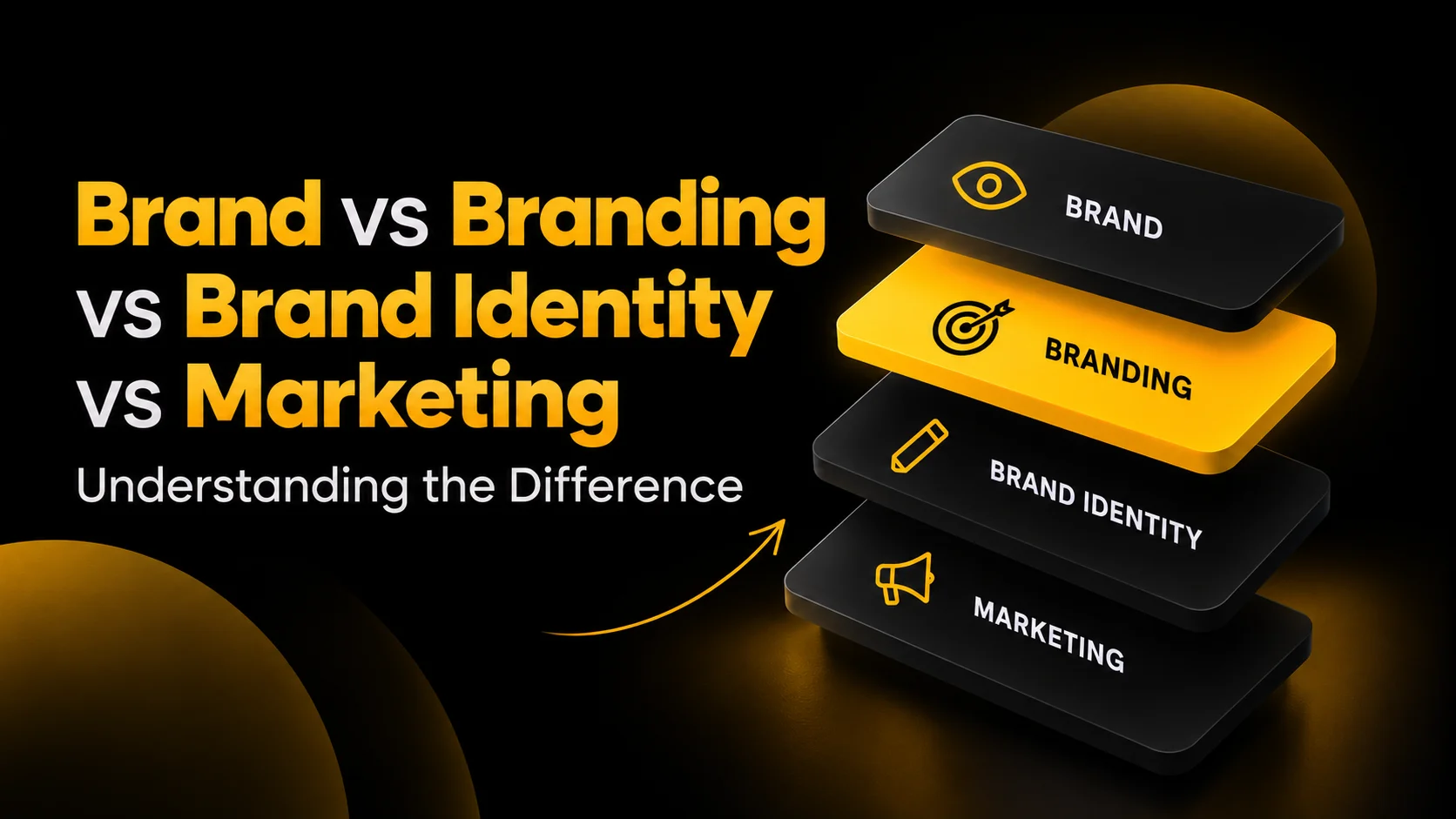
Brand vs Branding vs Brand Identity vs Marketing: Understanding the Difference
Businesses invest in logos, websites, advertising campaigns, SEO, and content marketing to grow. Yet, many still struggle to explain what makes their brand different from competitors.
The problem is often not a lack of marketing activity. It is a lack of clarity about the role each activity plays.
Brand, branding, brand identity, and marketing are closely connected, but they are not interchangeable. Confusing them can lead to businesses investing in the wrong things, expecting the wrong outcomes, and overlooking the real reasons customers choose one business over another.
Let's break down these four concepts, understand how they work together, and explore why the distinction matters for business growth.
1. Brand: The Perception
A brand is what people think, feel, and believe about a business. It is the collection of associations, expectations, and experiences that shape how customers perceive it.
A company can define how it wants to be perceived, but it cannot completely control how people actually perceive it. That perception develops through product quality, customer service, reputation, communication, and every interaction with the business.
Consider Apple. Its brand is associated with simplicity, design, innovation, and status. These associations are not created by its logo alone. They are reinforced through its products, retail experience, advertising, ecosystem, and customer interactions.
The key takeaway: A brand is not simply what a business says about itself. It is what people come to believe about it.
2. Branding: The Process of Shaping Perception
If a brand is the perception, branding is the deliberate process of influencing that perception.
Branding involves defining how a business wants to be understood and consistently communicating that meaning through its positioning, messaging, personality, customer experience, and other touchpoints.
Take Nike as an example. Its branding consistently reinforces ideas of performance, ambition, athleticism, and personal achievement. Its campaigns, athlete partnerships, storytelling, and product communication contribute to this positioning.
Branding is not limited to designing a logo or launching a campaign. It is an ongoing strategic effort to build meaningful associations and differentiate a business from its competitors.
The key takeaway: Branding is the work a business does to influence how people perceive it.
3. Brand Identity: The System of Expression
Brand identity is the collection of visual and verbal elements a business uses to express itself consistently.
Visual identity includes the logo, colors, typography, imagery, and design language. Verbal identity includes tone of voice, messaging, terminology, and communication style.
Coca-Cola demonstrates the importance of brand identity through its recognizable red color, distinctive typography, and iconic bottle shape. These elements help people recognize the brand across different platforms and environments.
However, recognition and reputation are not the same. A business can have a visually consistent identity and still struggle with customer trust, weak positioning, or a poor product experience.
A strong identity makes a business recognizable. Its broader brand perception depends on much more than visual consistency.
The key takeaway: Brand identity is the system through which a business expresses its personality and creates recognition.
4. Marketing: Reach and Action
Marketing connects a business with its target audience. It communicates value, creates demand, generates leads, supports sales, and encourages customers to take action.
SEO, paid advertising, content marketing, social media, email marketing, and conversion optimization are all part of the marketing toolkit.
Imagine a local café running Instagram ads to promote a special offer. The ads increase visibility, communicate the offer, and encourage people to visit. That is marketing in action.
But getting someone through the door is only part of the equation. Whether that customer returns depends on factors such as product quality, service, pricing, and the overall experience. Those experiences also influence the café's brand perception.
For digital marketers, this distinction matters. Campaign performance is influenced not only by targeting, creative, and landing pages, but also by how customers perceive the business behind the campaign.
The key takeaway: Marketing helps a business reach its audience, communicate value, and drive measurable outcomes.
5. How Brand, Branding, Brand Identity, and Marketing Work Together
These concepts are different, but they operate as parts of a connected system.
- Brand identity establishes how the business looks, sounds, and expresses itself.
- Branding uses strategic decisions and consistent experiences to shape perception.
- Brand is the perception and associations that develop in people's minds.
- Marketing communicates the proposition, reaches audiences, and encourages action.
In practice, the relationship is not strictly linear. Marketing campaigns also shape brand perception, while existing brand perceptions influence how people respond to marketing.
For example, two businesses can sell similar products and run campaigns on the same platforms. One may have clear positioning, a recognizable identity, and a reputation for reliability. The other may communicate generic promises and deliver inconsistent experiences.
Even with comparable advertising budgets, their results can differ because customers interpret their messages differently.
This is why marketing performance cannot always be improved by adjusting campaign settings alone. Sometimes, the underlying problem is unclear differentiation, weak messaging, or a lack of trust.
6. The Same Framework Across Different Businesses
The relationship between these concepts applies across industries, although the strategic priorities differ.
A sportswear brand
Identity: A recognizable visual system and product design.
Branding: Consistent associations with performance, ambition, and empowerment.
Brand: Customers feel that the brand represents their athletic goals or lifestyle.
Marketing: Advertising campaigns, athlete collaborations, product launches, and sponsorships.
A freelance designer
Identity: A professional portfolio, consistent presentation, and clear communication style.
Branding: Positioning around making complex ideas simple.
Brand: Potential clients perceive the designer as capable, reliable, and easy to work with.
Marketing: LinkedIn content, SEO, case studies, referrals, and networking.
A food delivery platform
Identity: Recognizable colors, typography, and interface elements.
Branding: A distinctive personality and communication style.
Brand: Customers associate the platform with convenience, value, or reliability.
Marketing: Promotional campaigns, notifications, partnerships, and customer acquisition activities.
The channels and creative approaches may change, but the underlying principle remains the same: businesses need a clear identity, deliberate brand-building, a meaningful market perception, and effective marketing.
7. Common Mistakes Businesses Make
Thinking a logo redesign will fix the brand. A new visual identity may improve recognition, but it cannot resolve unclear positioning or inconsistent customer experiences.
Expecting advertising to solve every problem. Paid campaigns can generate visibility and traffic, but they cannot reliably compensate for an unconvincing proposition or a poor product.
Measuring marketing only through immediate conversions. Short-term performance metrics are important, but they do not capture every aspect of brand recognition, trust, or long-term customer preference.
Confusing consistency with differentiation. A business can use the same colors, fonts, and messaging across every channel and still look exactly like its competitors. Consistency helps recognition; differentiation gives customers a reason to care.
Making promises the business cannot deliver. Branding can establish expectations, but the actual product and customer experience must support them. Otherwise, the gap between promise and reality can damage trust.
Conclusion: Branding Can Be Bought. Brand Must Be Earned.
A business can hire a designer to create its identity, a strategist to develop its branding, and a marketing team to execute campaigns. But it cannot simply purchase a positive reputation and expect customers to accept it.
Brand identity creates a consistent expression. Branding works to shape perception. Marketing communicates value and creates opportunities for action. The brand is what people ultimately come to think and feel about the business.
These activities work best when they reinforce one another. Strong marketing can bring people to a business, but the experience, value, and trust that follow influence whether those people become loyal customers.
Which of these four concepts do you think businesses misunderstand the most: brand, branding, brand identity, or marketing?