Ranking on Google Is No Longer Enough: A Practical Guide to Search Everywhere Optimization
When people need an answer, they do not always start with Google. They might search YouTube for a tutorial, browse Reddit for honest opinions, look for products on Amazon, explore Instagram for recommendations, or ask an AI tool such as ChatGPT for an explanation.
This shift in search behaviour is changing how businesses need to think about online visibility. Ranking well on Google remains important, but it is no longer the only way people discover brands, compare options, and make decisions.
That is where Search Everywhere Optimization comes in. It is an approach to improving your brand's discoverability across the platforms your audience uses to find information, products, and services.
The goal is not to appear on every platform simply for the sake of being everywhere. It is to build a useful, consistent presence wherever your potential customers are actively searching.
What Is SEO, and Why Does It Still Matter?
Search Engine Optimization (SEO) is the process of improving a website so that search engines can understand its content and users can discover relevant pages through organic search results.
Traditional SEO includes several important areas:
- On-page SEO: Improving page content, headings, titles, internal links, and search intent alignment.
- Technical SEO: Making sure search engines can crawl, index, and understand your website, while addressing issues such as performance and mobile usability.
- Off-page SEO: Building credibility through relevant backlinks, genuine brand mentions, and other legitimate reputation-building activities.
- Local SEO: Improving visibility for geographically relevant searches through your website, business information, and Google Business Profile.
These fundamentals are not obsolete. They remain essential to online visibility, including visibility in Google's AI-powered search experiences.
However, the wider discovery journey has expanded. Depending on the business and its audience, people may discover a brand through a traditional search result, a video, a social media post, a community discussion, or an AI-generated answer.
What Is Search Everywhere Optimization?
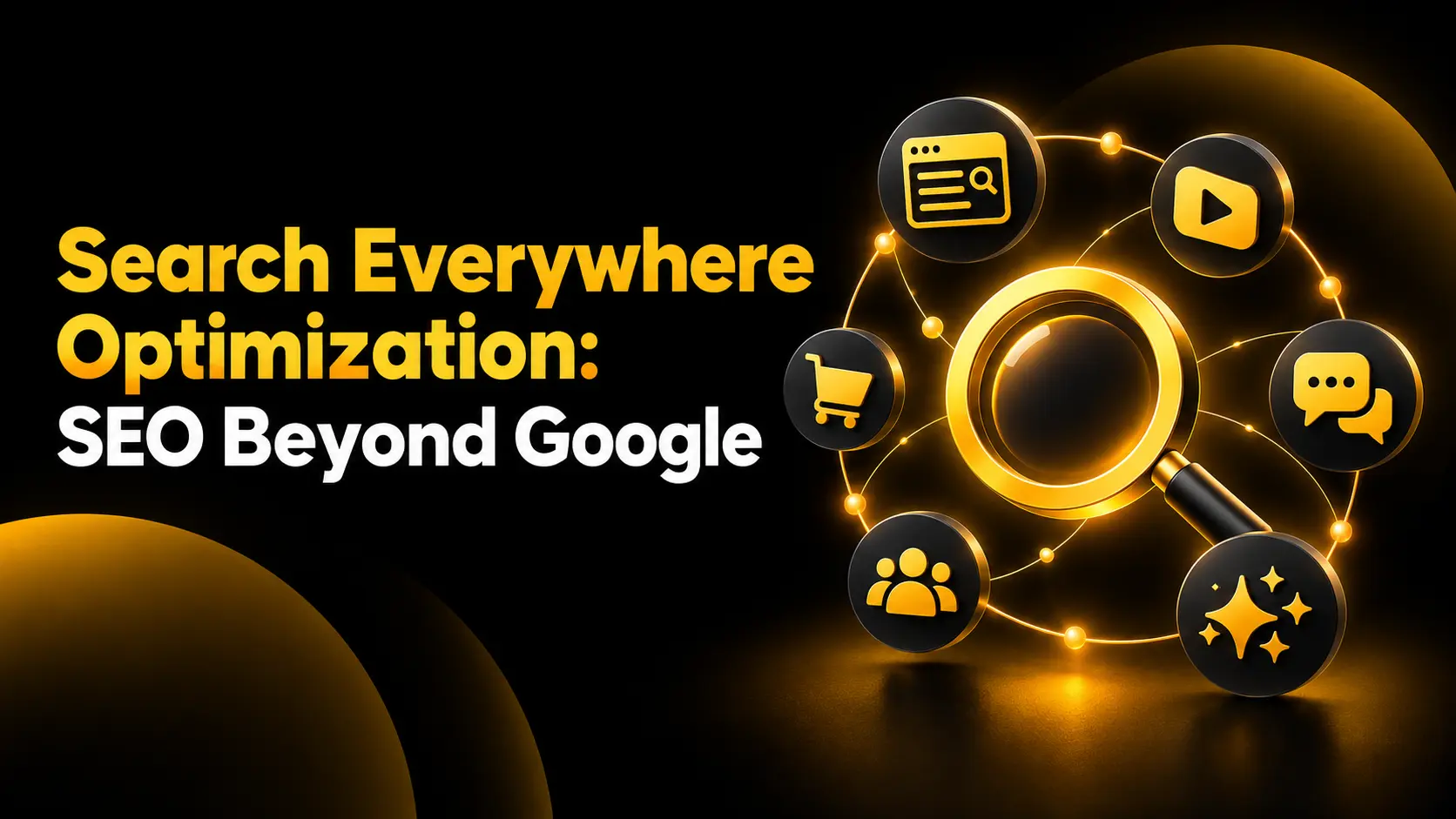
Search Everywhere Optimization is the practice of improving your brand's visibility across the different platforms and experiences people use to search for information, evaluate options, and discover solutions.
Depending on your industry, these platforms may include:
- Search engines: Google and Bing.
- Video platforms: YouTube and TikTok.
- Social platforms: Instagram, LinkedIn, and Pinterest.
- Online communities: Reddit and relevant industry forums.
- Marketplaces: Amazon and other platforms where people research or purchase products.
- AI-powered search: ChatGPT, Perplexity, and Google's AI Overviews and AI Mode.
- Voice and device-based search: Voice assistants and search features built into apps and devices.
Each platform has its own content formats, discovery mechanisms, and user expectations. A detailed website article may work well for an informational Google search, while a demonstration video may be more useful to someone searching YouTube.
Search Everywhere Optimization brings these activities together under one broader objective: helping the right people discover your business through the channels that matter to them.
It also connects with a broader marketing principle. Digital marketing works best when its channels support a common business goal rather than operating independently. You can explore this idea further in my article on why digital marketing is a strategy, not just a collection of channels.
Why Search Behaviour Is Changing
People choose where to search based on what they need, how quickly they want an answer, and which sources they trust. Several developments are making this behaviour increasingly important for businesses.
People Want Answers in Different Formats
Someone learning a practical skill may prefer a video. Someone comparing professional services may read detailed website pages and customer reviews. Someone researching a complex topic may use an AI tool to understand the basics before visiting individual websites.
Businesses can respond by providing useful information in the formats that best serve their audiences, rather than relying exclusively on blog articles or social media posts.
Communities Influence Buying Decisions
People often look beyond a company's own marketing messages before making a decision. They may read Reddit discussions, watch independent product reviews, or compare customer feedback on relevant platforms.
This makes genuine reputation and customer experience important parts of online discoverability. Businesses should encourage honest reviews, respond constructively to feedback, and provide information that helps people evaluate their options.
Video and Social Search Serve Different Needs
Video and social platforms allow people to discover products, learn new skills, see demonstrations, and explore recommendations. Their search features can be particularly useful for visual, practical, or community-driven topics.
However, not every business needs to invest equally in every platform. A business should prioritize the channels that align with its audience, offer, resources, and objectives.
AI Is Changing How People Discover Information
AI-powered search experiences can summarize information, compare alternatives, and provide links to supporting sources. This changes how some users move from an initial question to a more detailed investigation.
It does not mean that websites are no longer important. Google's documentation explains that its AI search features continue to rely on established SEO fundamentals. A page must meet the relevant technical requirements to be eligible for inclusion, and meeting those requirements does not guarantee that it will appear.
For practical guidance, see Google's official documentation on AI features and your website.
Key SEO Approaches for Search Everywhere Optimization
Search Everywhere Optimization is not a replacement for SEO. It expands the way businesses plan and execute their discoverability efforts. The following approaches address different parts of that process.
1. Generative Engine Optimization (GEO)
Generative Engine Optimization (GEO) refers to efforts to improve a brand's visibility in AI-generated search experiences and responses.
Useful practices include publishing accurate, original content, demonstrating relevant expertise, making important information accessible to search engines, and explaining complex subjects clearly.
For Google AI Overviews and AI Mode, Google states that established SEO best practices remain relevant and that no additional special optimization is required. No GEO technique can guarantee that an AI system will cite or recommend a particular website.
2. Answer Engine Optimization (AEO)
Answer Engine Optimization (AEO) focuses on making information easy to find and understand when users seek a direct answer to a question.
To support this goal, identify the questions your audience actually asks, answer them clearly, use descriptive headings, and provide enough context to make the answer useful.
FAQ sections can help readers navigate common questions, but adding FAQs does not automatically secure featured snippets, voice search placements, or AI citations.
3. Large Language Model Optimization (LLMO)
Large Language Model Optimization (LLMO) is a term used for efforts to help AI systems understand and accurately represent a brand, its expertise, and its content.
Practical priorities include maintaining accurate business information, publishing original expert content, explaining products and services consistently, and ensuring that important website information is accessible.
It is useful to treat LLMO as an evolving area of digital visibility rather than a separate technical formula with guaranteed outcomes. Strong SEO, useful content, and a credible online presence remain the foundation.
4. Video SEO
Video SEO involves optimizing videos so that people can discover and understand them through relevant search and recommendation experiences.
On YouTube, use descriptive titles, accurate descriptions, relevant chapters where appropriate, and clear explanations. Captions and transcripts can improve accessibility and help make spoken information available as text.
For short-form video platforms, focus on the questions your audience searches for, clear visual demonstrations, relevant captions, and content that delivers on its promise.
5. Social SEO
Social SEO focuses on making profiles and content easier to discover through social platform search and, where applicable, external search engines.
Use clear profile descriptions, accurate business information, relevant terminology, and useful content. A business selling professional services might prioritize LinkedIn, while a visually oriented business may find Instagram or Pinterest more relevant.
The objective is to make your presence useful and discoverable, not to repeat keywords unnaturally in every post.
6. Brand Visibility and Topical Authority
Search engines and AI systems need to interpret what a business does and how its content relates to a topic. A clear brand identity, consistent business information, and a useful collection of related content can help communicate that context.
Publishing interconnected articles that answer different questions within your area of expertise also helps readers explore a subject in greater depth.
For example, a digital marketing professional might publish guides about SEO, website performance, content strategy, and online visibility. Each article should offer genuine value rather than simply repeat the same information with different keywords.
Brand recognition is also connected to how people perceive and remember a business. My article on brand, branding, brand identity, and marketing explores these related concepts.
7. Search Intent Optimization
Search intent is the reason behind a query. Understanding that reason helps you decide what kind of content to create and how much detail to provide.
- Informational intent: Someone wants to understand a topic or solve a problem.
- Commercial investigation: Someone is comparing products, providers, or possible solutions.
- Transactional intent: Someone is ready to buy, book, or take another specific action.
- Navigational intent: Someone is trying to find a particular business, brand, or website.
For example, a person searching for "what is technical SEO" needs an explanation, while someone searching for "SEO services for a small business" may be evaluating providers.
Matching the content to the user's actual need is more useful than trying to rank every page for the same broad keyword.
Why Your Website Still Matters
Expanding your presence across search platforms does not reduce the importance of your website. Your website can serve as the central place where people verify your business, understand your services, explore your expertise, and decide whether to contact you.
It also gives you more control over your content and the experience you provide than relying entirely on third-party platforms.
A well-maintained website supports discoverability through clear information architecture, helpful content, relevant internal links, and a technically sound foundation. It also gives you a destination for visitors who discover your business through social media, video, referrals, or AI-powered search.
For a deeper explanation, read my article on why your website matters in digital marketing.
For further technical guidance, Google's SEO Starter Guide explains the fundamentals of helping search engines crawl, index, and understand website content.
How to Build a Practical Search Everywhere Strategy
You do not need to establish a presence on every platform at once. Start with your existing website and the channels that are most relevant to your customers.
- Strengthen your website's SEO foundations. Review crawling and indexing, page titles, content quality, internal links, mobile usability, and performance. Fix the issues that prevent important pages from being discovered or used effectively.
- Understand your audience's search behaviour. Identify the questions people ask, the platforms they use, the alternatives they compare, and the information they need before choosing a provider.
- Publish useful, original content. Create pages and articles that answer real questions, demonstrate your expertise, and offer something more useful than a generic summary.
- Adapt content to relevant platforms. Turn a detailed article into a useful video, a professional social post, or a practical discussion where appropriate. Adapt the format to the platform instead of copying the same content everywhere.
- Maintain accurate brand information. Keep your business name, services, contact information, and descriptions consistent and up to date across relevant platforms.
- Build genuine credibility. Encourage honest customer reviews, earn relevant editorial mentions, and develop relationships that strengthen your reputation. Avoid buying artificial engagement or manufacturing mentions solely to influence algorithms.
- Use structured data appropriately. Implement relevant schema markup when it helps search engines understand your pages or makes them eligible for supported rich results. Do not treat schema as a guarantee of rankings or AI visibility.
- Measure what matters. Monitor organic search performance, relevant referral traffic, qualified enquiries, conversions, and the results of your activity on other platforms. Use the data to decide where further effort is justified.
Prioritize the platforms that align with your business goals. A local service provider may benefit most from local SEO, useful website content, and genuine reviews. A product business may need stronger marketplace visibility, product pages, and video demonstrations. A B2B company may prioritize search engines, industry publications, and LinkedIn.
Common Search Everywhere Optimization Mistakes
- Focusing only on rankings: Rankings matter, but qualified visitors, relevant visibility, enquiries, and business outcomes provide a fuller picture of performance.
- Trying to be present everywhere: Managing too many platforms can dilute your resources. Choose channels based on audience behaviour and business objectives.
- Chasing AI citations with shortcuts: There is no guaranteed formula for appearing in AI-generated answers. Focus on useful content, accessibility, accuracy, and established SEO fundamentals.
- Publishing content without original value: Repeating common advice without adding expertise, examples, evidence, or a useful perspective gives readers little reason to choose your content.
- Ignoring the website experience: Visibility alone is insufficient if visitors cannot understand your offer, navigate your pages, or contact your business easily.
- Measuring activity instead of outcomes: More posts, impressions, or mentions do not necessarily mean more customers. Evaluate whether your efforts are reaching the right audience and supporting your goals.
The Bottom Line
SEO is not becoming irrelevant. The ways people discover information are expanding, and businesses need to understand how traditional search, social platforms, video, communities, and AI-powered experiences fit into that changing landscape.
Search Everywhere Optimization provides a broader way to think about online visibility. It encourages businesses to build a strong website, publish genuinely useful content, maintain a credible brand presence, and prioritize the platforms their audiences actually use.
You do not need to overhaul your entire marketing strategy overnight. Start with your SEO foundations, identify your most relevant discovery channels, and improve your presence step by step. Measure the results and invest more effort where it creates meaningful value.
The goal is not simply to appear everywhere. It is to be discoverable, credible, and useful wherever your potential customers are looking for answers.
Need Help Improving Your Search Visibility?
If your business needs a clearer SEO strategy, stronger website visibility, or help attracting more relevant organic traffic, explore my SEO services.
From SEO audits and keyword research to on-page optimization, local visibility, and content strategy, I help businesses build a stronger search presence around their goals.